
 Book Now (Save £60)
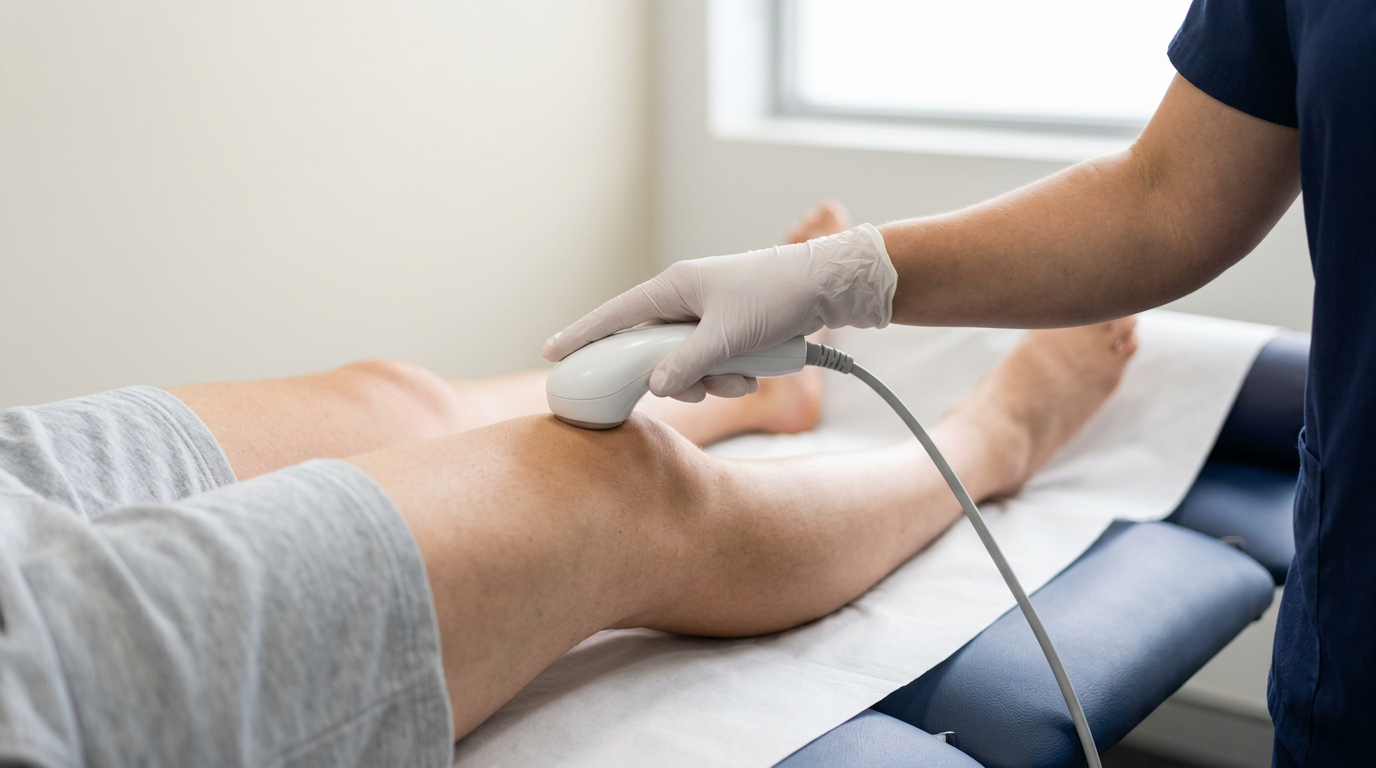
If you are searching for electrotherapy in Reading, you may have seen TECAR, ultrasound and IFT and wondered what they involve. At Kinetic Care in Green Park, Rupali Mandve, an HCPC-registered physiotherapist, uses them as supporting tools. They sit inside a physiotherapy plan that also includes manual therapy, exercise and home advice.
This guide explains what each one is, what it feels like and how Rupali decides whether it suits you.
What is electrotherapy?
Electrotherapy means using a controlled form of energy, applied through the skin, to create a physical effect in the tissues. Treatments like therapeutic ultrasound, TECAR and IFT use sound waves, radiofrequency energy or low-level forms of electrical energy. Older textbooks call the field electrotherapeutics.
Rupali applies each device with gel or sticky pads. She will calibrate the settings to you and to how you feel on the day.
People ask about it for many musculoskeletal conditions. These range from osteoarthritis to sports injuries and soft tissue injuries, such as a ligament sprain. Whether it has a place depends on your assessment. This guide makes no claim for any single condition.
Does electrotherapy work? What the research says
Research on electrotherapy used on its own is mixed. Some trials compared to sham find small or no measurable difference. That is why, in clinical practice, Rupali treats it as a supporting tool. It is never the whole plan.
People often look for pain relief, and the research is mixed there too. You can search PubMed for trials on each technique. Evidence-based care means being honest about what is uncertain. Any therapeutic effect may also vary from person to person.
If you have persistent discomfort, such as back pain or joint stiffness, rehabilitation usually matters most. That means understanding how you move, building strength and changing daily habits. Chronic pain and pain management are complex, and no single device answers them. A supporting tool may give you a more comfortable starting point within a wider programme.
TECAR therapy: gentle warmth from radiofrequency energy
TECAR stands for Transfer of Energy Capacitive and Resistive. Rupali delivers it with a Winback device and has completed an advanced Winback TECAR course. The device uses high-frequency radiofrequency energy in two modes.
The capacitive mode tends to act on softer, more superficial tissue. The resistive mode reaches slightly deeper. Rupali chooses between them to adjust where the warmth is concentrated.
Warmth is thought to increase local blood flow. It is also thought to make collagen-rich tissue more extensible, which may make stretching easier.
Many people describe a comfortable, spreading warmth. It is a little like a hot water bottle that moves with the handpiece. Tell Rupali if it feels too warm and she will adjust it.
A TECAR session is typically around 20 to 30 minutes. It is usually combined with manual therapy and exercise, so the warmth is followed by movement work.
Therapeutic ultrasound: targeted sound waves
Therapeutic ultrasound is not the scan used to look at a baby or an organ. It sends acoustic energy, in the form of sound waves too high-pitched to hear, into a small area of tissue. Rupali moves a handheld head slowly over gel on your skin. The gel lets the sound pass into the body.
Machines commonly run at 1 MHz or 3 MHz. Frequency affects tissue depth. The lower frequency travels deeper, so Rupali picks it for deep tissue.
The waves create tiny vibrations and, depending on the settings, mild warming. Because the treated area is small, ultrasound suits a specific spot better than a wide area of tightness.
You will feel cool gel and the smooth movement of the head. Many people feel very little else, and some notice faint warmth. It should never be painful.
Interferential therapy (IFT): crossing currents you feel as a tingle
Interferential therapy, or IFT, uses electrode pads placed on the skin around the area being treated. It runs two simultaneous medium-frequency currents. Currents at this frequency pass through skin more comfortably than low-frequency ones.
The two currents cross in the tissue beneath the pads. Where they meet, they combine into a lower-frequency effect. This interference gives the treatment its name. How far the current reaches depends on the settings and your build.
Some people find the sensation helps settle discomfort before they move. The main feeling is tingling, sometimes described as buzzing or pins and needles. Rupali turns the strength up slowly until you feel it clearly but comfortably. You stay still in a supported position while it runs.
How is it different from TENS and NMES?
Other forms of electrical stimulation exist, and you may hear about them. Kinetic Care does not currently offer TENS or NMES as in-clinic treatments. The three used at the clinic are TECAR, ultrasound and IFT, described above. This section explains the difference so you know what you are, and are not, being offered.
TENS stands for transcutaneous electrical nerve stimulation. Pads send low-frequency electrical impulses through the skin to sensory nerves. The gate control theory suggests this kind of nerve stimulation may block pain signals on their way to the brain. It remains a theory, and home units are widely sold.
NMES stands for neuromuscular electrical stimulation. It sends impulses to motor nerves so that a muscle contracts. In rehabilitation, this neuromuscular stimulation is sometimes used for muscle re-education and muscle recruitment. It comes up when a muscle switches off after immobilisation or in post-operative care. This is known as inhibition.
Which modality might suit you, and when is it not safe?
Broadly, TECAR may suit warmth over a wider area, ultrasound a small target and IFT a tingling sensation. The choice follows your assessment. Targeted electrotherapy makes sense only when it fits your problem.
Rupali also screens for any contraindication before a device is used. She asks about your medical history and your risk profile. Examples include:
- A cardiac pacemaker or other implanted electronic device
- Pregnancy
- Some metal implants
- Broken, irritated or numb skin over the area
This is not a complete list. Please tell Rupali about anything relevant, even if it seems unconnected to your main concern.
What happens at your appointment in Green Park, Reading
Kinetic Care is at Green Park, Reading RG2 6UB, near M4 Junction 11. Loose, comfortable clothing makes it easier to examine the area.
- A conversation. You describe what has been troubling you and what you would like to do more comfortably.
- An assessment. Rupali checks how you move, including your range of motion and strength.
- An explanation. She explains what she thinks is going on and outlines your treatment plan.
- Treatment, if appropriate. This may include hands-on therapy, exercise and, where the assessment supports it, TECAR, ultrasound or IFT.
- Home exercise advice. You leave with simple guidance for between visits.
Assessment comes first. Sometimes electrotherapy is not used at all, and the session relies on manual therapy and exercise alone.
Before any device is used, Rupali explains the clinical setup. She tells you what you are likely to feel and what the alternatives are. You can decline or stop at any point. Rupali is the sole practitioner, with around 15 years in practice, so you see the same person each visit.
Frequently asked questions
Does electrotherapy hurt or feel like an electric shock?
It should not. TECAR usually feels like warmth, ultrasound often feels like very little and IFT feels like tingling. If you feel a sharp or burning sensation, tell Rupali straight away and she will adjust the settings or stop.
How long does a session last?
TECAR is typically around 20 to 30 minutes. The rest of the appointment depends on what else is included, such as exercise and advice.
Is electrotherapy safe for everyone?
No. The screening list above shows situations where it may not be suitable. That is why Rupali asks about your history before starting.
Can I use electrotherapy at home, or is it a clinical tool?
Home TENS units exist. Ask a physiotherapist before using one. In a clinical setting, clinical-grade equipment is set and supervised for you.
Is electrotherapy available on the NHS?
NHS physiotherapy services decide locally which treatments they offer. This guide describes private physiotherapy at Kinetic Care. You can usually book privately without a GP referral, though if your symptoms are severe, sudden or unclear, seeing your GP first is a sensible option. Otherwise, involving your GP is your choice.
Book an electrotherapy assessment in Reading
Electrotherapy can be a useful part of rehabilitation when it is chosen carefully and combined with movement. If you are unsure whether it would suit you, an assessment is the simplest next step. Rupali will only recommend it if it fits.
You can book an assessment with Rupali at Green Park, Reading, or call the clinic on 07350 350265. To read more, see the electrotherapy page.
Comments are closed